





















A website and application maintenance agreement should identify the systems covered, included work, support hours, service measurement rules, ownership of access and backups, and procedures for changes and termination. Separate response time from service restoration and permanent resolution. Before agreeing on a fee, make sure both parties understand the evidence they will receive and the work that remains the client's responsibility.
A document that promises only “monthly maintenance” does not explain what happens when a form stops working, a certificate expires, or users request a new report. When discussing requirements with FourVM, start with critical business processes and the system's current condition. This guide covers operational matters to agree on; it is not a legal contract form ready for signature.
Start with an asset list and an agreed baseline
List the websites, applications, domains, server environments, repositories, and integrations included in the service. Distinguish production from test environments. If an application uses a payment service or another third-party system, record who owns the account and who may contact that provider.
Next, agree on the baseline: functions that already work, unresolved issues, known component versions, and available documentation. This record helps distinguish maintenance of agreed functionality from remediation of pre-existing problems. For websites, compare the list with FourVM's website development scope, including areas managed through the content management system.
Separate defects routine work and change requests
A defect is a departure from agreed behavior that can be described and reproduced. A change request adds to or alters that behavior. A form that fails to send data may be defective; adding a new approval stage may require additional development. Classification should follow the baseline and investigation findings, rather than the label chosen by the person reporting it.
Routine work forms a third category, such as reviewing updates, checking backups, or monitoring service expiry dates. Specify its frequency and the evidence of completion. Requirements that change application workflows should be discussed against a separate scope; FourVM's business application development services provide useful context. Do not classify every request as a defect, but do not charge for a change before explaining the classification either.
Define support hours and three different time measures
A service level agreement, or SLA, needs measurement rules that both parties can understand. Atlassian's documentation describes targets, calendars, and conditions for starting, pausing, and stopping SLA measurements. In your agreement, specify the time zone, working days, public holidays, reporting channels, and event that starts the clock.
Response time: when the team acknowledges the report, checks the initial information, and explains the next action.
Restoration time: when the critical function becomes usable again, including through an agreed temporary workaround.
Permanent resolution time: when the underlying fault is corrected and the result is verified.
These measures do not automatically have the same target. A message saying “we are investigating” is not evidence that service has been restored. Set priorities using business impact and urgency: stopped transaction processing is different from a visual issue that does not block work. Also identify who can raise the priority when the impact changes.
How to read a two business hour target
The following figures are illustrative and are not FourVM's SLA or an offer. Assume support operates Monday to Friday, from 09:00 to 17:00 Western Indonesian Time, UTC+7, with no public holidays, and the response target is two business hours. A complete report arrives on Friday at 16:00. One hour counts on Friday until 17:00; the remaining hour counts on Monday from 09:00. The response deadline is therefore Monday at 10:00.
If the business needs weekend coverage, discuss it explicitly. Do not interpret two business hours as two elapsed hours. Waiting for client information does not automatically pause an SLA clock either. Agree on pause conditions, notification requirements, and when measurement resumes, and keep a record of those events.
Use a responsibility matrix that produces evidence
The system owner and support provider should know who performs each task, who approves it, and what evidence is retained. The following matrix is a discussion example, rather than a division of responsibilities that applies to every project.
| Activity | Example division of roles | Evidence to check |
|---|---|---|
| Incident classification | The provider investigates; the business contact explains the impact. | Ticket, priority, and classification rationale. |
| Component updates | The provider tests; the owner approves the release window. | Test record, approval, and verification results. |
| Backup and recovery | The infrastructure operator performs the task; the application contact checks functionality. | Backup logs and recovery test results. |
| Privileged access | The owner authorizes access; the provider uses it for the assigned work. | Access register and revocation record. |
| Feature changes | The business team defines the requirement; the provider estimates the work. | Scope, cost, schedule, and change acceptance. |
Pay particular attention to the boundary between application maintenance and cloud and hosting management. A running server does not prove that forms or integrations work. Equally, a code fix does not resolve every network problem or third-party account issue.
Include prevention and recovery in the scope
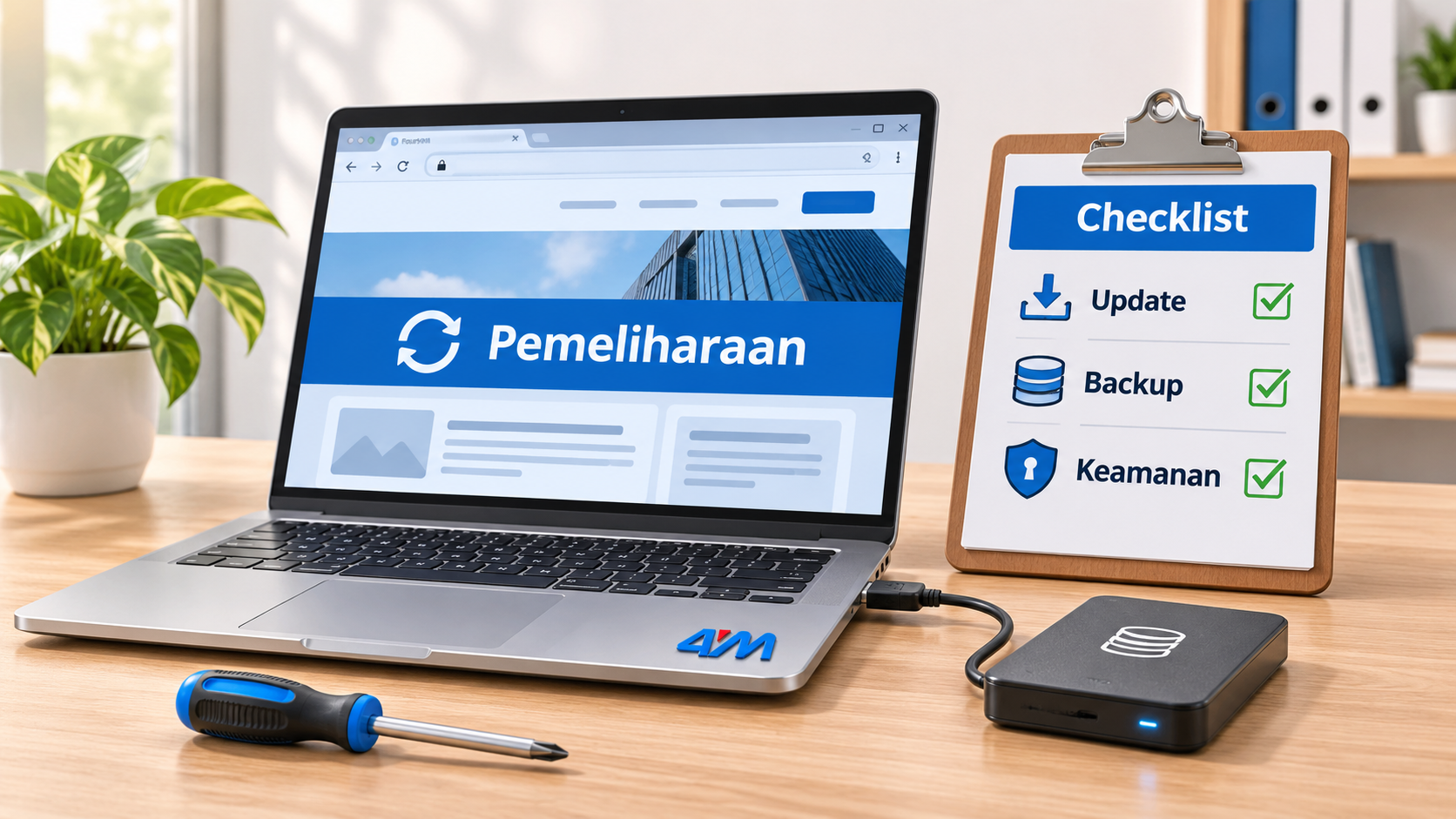
NIST SP 800-40 Rev. 4 treats patching as preventive maintenance, covering identification, prioritization, installation, and verification. Ask who monitors updates, tests their impact, and verifies the outcome after installation. Do not assume that automatic updates suit every component.
For backups, agree on the data covered, storage location, retention, responsible party, and how recovery will be checked. Successfully creating a backup file is different from successfully restoring the application. Where infrastructure is involved, FourVM Cloud offers a reference point for discussing servers and managed services. Specifications, support, and responsibility boundaries still need to be agreed for the particular project.
Illustrative case study 1 a distributor loses order processing
In this fictional example, a distributor receives a quick ticket response, but its order form remains unusable. The support document records only a response time. The sales team assumes that the reply means a fix will be completed shortly, while technical staff are still investigating an integration problem.
The parties then distinguish acknowledgment, functional restoration, and permanent resolution. The business contact identifies the information needed to record orders temporarily. Technical staff record investigation status and the next communication update. The workaround is not immediately treated as the final fix; the function must still be tested before the ticket is closed.
The lesson is to assess support against observable business conditions. Google Cloud's incident management guidance emphasizes roles, communication, and escalation. Here, those principles become named contacts, a status channel, and clear restoration criteria, without promising that an incident will always be resolved within a particular duration.
Illustrative case study 2 a new report is treated as maintenance
A fictional company uses an internal application with an existing monthly report. Users then request a comparison across branches, with different approval rules. They submit it as a “report fix”, although the baseline does not include the new functionality. At the same time, a calculation in the original report does not match its specification.
The team separates the tickets. The calculation discrepancy is investigated as a suspected defect against the baseline, while the cross-branch comparison becomes a scope change. Before releasing the correction, staff use test data and ask the business contact to check the expected result. Production access is granted for the assigned task and reviewed again after completion.
This example does not decide who must pay before investigation. Its lesson is to make classification traceable through the requirement reference, test steps, decision rationale, and approval. Maintenance should not become an unlimited development backlog, while genuine defects should still receive appropriate attention.
Agree on reporting change costs and service termination
Request a report covering incoming tickets, routine tasks, recurring incidents, implemented changes, and unresolved risks. Ticket closure counts alone do not show whether critical processes are working again. For significant incidents, record the cause, preventive actions, and person responsible for follow-up.
Explain change costs before additional work begins: scope, assumptions, revision limits, schedule effects, and the approving party. Connect recurring components with planning the total cost of website ownership. Maintenance, hosting, licensing, and further development are not interchangeable costs unless their relationship is explained.
Finally, agree on the process when service ends: returning or revoking access, handing over current documentation, listing open tasks, confirming backup status, and arranging the transition. Distinguish organization-owned access from licenses or services tied to the provider. Ownership and usage rights should be documented according to the parties' agreement.
A checklist before approving the service
The asset list, environments, and starting condition are understood.
Defects, routine tasks, feature changes, and exclusions can be distinguished.
Support hours, priorities, time targets, and pause conditions have definitions.
Each activity has an operator, an approver, and evidence of completion.
Access, backups, testing, reporting, and the end-of-service transition are discussed.
Bring this checklist to a maintenance discussion with FourVM. Start with the functions that matter most to everyday work, then ask for broad terms to be translated into actions and evidence. A service becomes easier to evaluate when its scope is clear to both the system owner and the team delivering it.
Sources & References
- Atlassian Support — What are SLAs Publication date not shown in the inspected section. Accessed 17 November 2026
- Google Cloud — Manage incidents and problems Last reviewed 2026-10-28 UTC. Accessed 17 November 2026
- NIST CSRC — SP 800-40 Rev 4 Guide to Enterprise Patch Management Planning April 2022. Accessed 17 November 2026
- FourVM — Company Profile Content V2.0. Brand facts and service scope; not independent validation